AI-Generated Email Attacks: When the Lure Writes Itself
AI now shapes over 8 in 10 phishing emails and beats elite human red teams. What machine-written lures change — and how to defend your workforce.
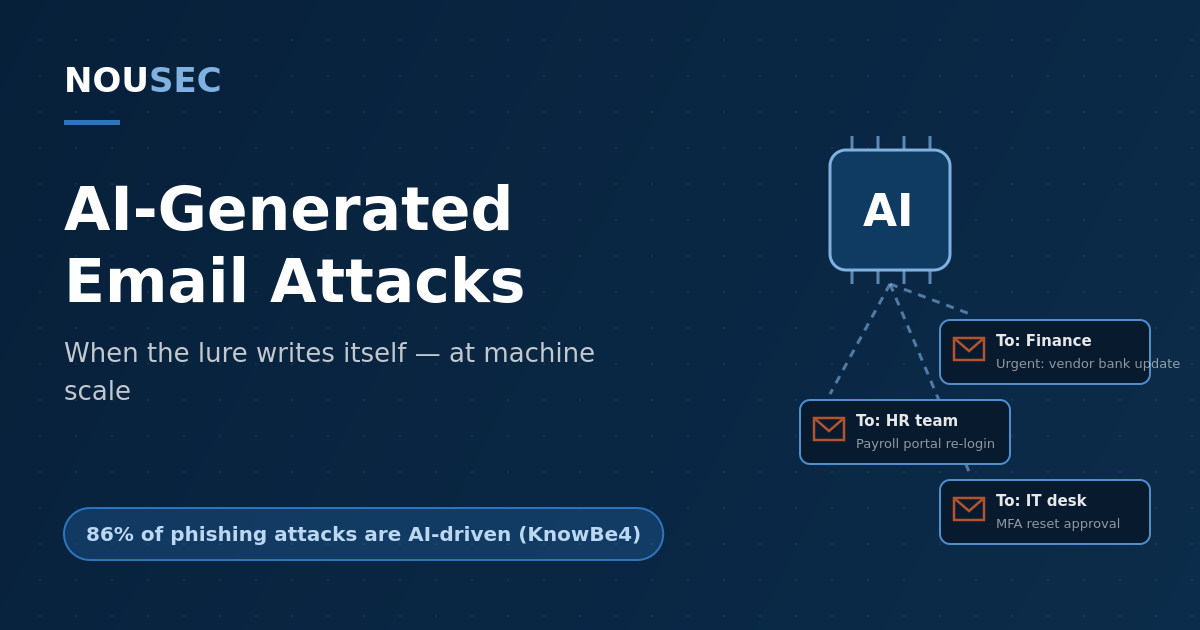
For years, the security industry debated whether generative AI would really change phishing or just polish it. That debate is over, and the data settled it. Machine-written lures are no longer an emerging threat to keep an eye on — they are the majority of what lands in your employees' inboxes, and in controlled studies they now out-phish the elite human professionals whose job is writing convincing attacks.
This matters for one uncomfortable reason: most security awareness programs still train people to spot the artifacts of human sloppiness — typos, clumsy phrasing, generic greetings. AI removed those artifacts at industrial scale. The lure has changed; most training hasn't.
Here is what the evidence actually shows, what AI changes about the attack economics, and how to rebuild your human defenses for lures that write themselves.
The numbers: machine-written lures are now the norm
Three independent lines of research — vendor telemetry, large-scale simulation experiments, and academic trials on human subjects — point the same direction.
| Source | Finding |
|---|---|
| KnowBe4 Phishing Threat Trends, Vol. 5 (Mar 2025) | 82.6% of phishing emails analyzed (Sep 2024–Feb 2025) showed some use of AI; 76.4% of campaigns used polymorphic variation to evade filters |
| KnowBe4 research (Apr 2026) | 86% of phishing attacks AI-driven across 3,000+ tracked threat actors; Microsoft Teams attacks up 41%; 30% of Q1 2026 attacks impersonated internal teams |
| Hoxhunt simulation research (2023–2025) | Elite human red teams beat AI by ~45% in 2023; by March 2025 the AI agent was ~24% more effective than the humans — a 55% relative swing in two years |
| Heiding, Lermen, Kao, Schneier & Vishwanath (academic study, 2024) | Fully AI-automated spear phishing hit a 54% click-through rate vs. 12% for generic phishing — on par with human experts, at a fraction of the cost |
Treat the vendor figures as directional bands rather than precise measurements — detection of "AI use" in an email is itself probabilistic. But the direction is unambiguous, and the academic results remove any doubt about capability: in the Heiding et al. trials, an automated pipeline gathered open-source intelligence on each target, built a personalization profile (accurate and useful in 88% of cases), wrote the lure, and matched human experts click for click. The authors estimate the economics improve attacker profitability by up to 50 times on large campaigns.
The trade-off that protected us for twenty years is gone. Attackers used to choose between mass volume and hand-crafted personalization. AI delivers both at once — every employee can now get the spear-phishing treatment.
What AI actually changes — and what it doesn't
Personalization at mass scale. Spear phishing used to be reserved for executives and finance because research took hours per target. An LLM pipeline does the research and the writing in seconds, so the intern gets the same tailored treatment as the CFO. KnowBe4's finding that 30% of attacks now impersonate internal teams — HR, IT, payroll — reflects exactly this: convincing internal voice used to be hard to fake, and now it isn't.
Polymorphic evasion. When three-quarters of campaigns ship subtly varied copies of each lure, signature-based filters chase a moving target. Every recipient can receive a structurally unique email with the same intent.
The death of the grammar tell. Fluent, idiomatic, correctly branded email is now the baseline — in any language. Awareness content that teaches "watch for spelling mistakes" is training people to clear a bar the attacker no longer trips over.
Multi-channel convergence. The same models write the email, the SMS, and the script for the follow-up call. CrowdStrike recorded a 442% increase in vishing in the second half of 2024, and voice cloning now needs only seconds of sampled audio — we cover that escalation in our guide to deepfake voice attacks on finance teams. The FBI's IC3 warning on generative AI fraud spans the full stack: AI-written text, AI images, cloned voices, and synthetic video, with Deloitte projecting GenAI-enabled fraud losses to reach $40 billion by 2027 in the US alone.
What doesn't change: the ask. Every one of these attacks still ends the same way — a request to click, pay, share credentials, approve an MFA prompt, or bypass a process. AI transforms the packaging, not the objective. That constant is the foundation your defense gets rebuilt on.
Why legacy defenses and legacy training both miss
Verizon's 2026 DBIR keeps the human element steady at 62% of breaches, and adds two findings that should worry anyone whose program was designed in 2020: social engineering delivered on mobile devices was 40% more successful than classic email phishing, and the share of employees using unsanctioned "shadow AI" tools tripled from 15% to 45% — meaning your people are simultaneously facing better attacks and feeding sensitive context into tools you don't control.
Meanwhile the filter layer is fighting probability, not signatures. Some AI-written lures will always get through, because they are individually novel, grammatically clean, and increasingly sent from legitimate compromised accounts. The last control in the chain is the same as it always was: a human deciding whether to comply.
How to defend: a practical program for the AI era
1. Retrain the tells — from prose to intent. Replace "spot the typo" content with request-centric judgment: Is this unusual? Is it urgent? Does it ask me to move money, share credentials, approve access, or keep quiet? Teach employees that a perfectly written email carries zero evidence of legitimacy — polish is now free.
2. Make verification procedural, not personal. Out-of-band callback on a known number for any payment change, credential reset, or MFA modification — no matter how authentic the request looks or sounds. The FBI explicitly recommends agreeing on a shared verification word for high-risk approvals. Verification must be policy employees are rewarded for following, even when the "CEO" is annoyed.
3. Remove the prize with phishing-resistant authentication. A flawless credential-harvesting page is worthless against a passkey, because there is no password to type and the credential is bound to the real domain. Our passkeys and FIDO2 migration guide covers the rollout path; pair it with number matching and MFA hygiene in the interim.
4. Simulate at AI difficulty. If attackers use AI-grade lures and your phishing simulations still send obvious templates, you are measuring — and building — resilience against an attack that no longer exists. Use AI-generated, personalized simulations across email, SMS, and chat, and treat report rate, not click rate, as your north-star metric.
5. Quantify who is exposed. AI attackers personalize by role and access; your defense should too. A Human Risk Score that combines simulation behavior, real reporting activity, and privilege level tells you which teams need verification drills before the attacker runs the same calculation. That per-person view is the core of modern human risk management.
6. Govern the AI on your side of the fence. Shadow AI is both a data-leak channel and a fresh attack surface — assistants can be manipulated through prompt injection hidden in the very emails and documents they process. Approved tools, least-privilege access, and clear usage policy belong in the same program.
The uncomfortable truth of the AI era is also the reassuring one: the attack's final step still runs on human trust, and human trust can be trained, measured, and reinforced. The organizations that thrive will be the ones that stopped teaching employees to grade grammar — and started teaching them to interrogate requests.
Frequently asked questions
How common is AI-generated phishing?
Very. KnowBe4's Phishing Threat Trends research found that 82.6% of phishing emails analyzed between September 2024 and February 2025 showed some use of AI, and its April 2026 research put the share of AI-driven phishing attacks at 86%. AI-assisted writing has moved from novelty to default: the typo-ridden phish is now the exception, not the rule.
Is AI-generated phishing actually more effective than human-written phishing?
By some measures it now beats professionals. In Hoxhunt's large-scale simulation research, elite human red teams outperformed AI by roughly 45% in 2023 — but by March 2025 the AI agent was about 24% more effective than the humans. A separate academic study by Heiding et al. found fully AI-automated spear phishing achieved a 54% click-through rate, on par with human experts and roughly 4.5 times the generic-phishing control group.
Can employees still spot AI-written phishing emails?
Not by the old tells. Broken grammar, odd phrasing, and generic greetings — the signals most awareness programs taught for years — are gone from machine-written lures. Employees can still catch AI-generated attacks, but only if training shifts from proofreading to context: is this request unusual, urgent, and asking me to move money, share credentials, or bypass a process? The ask is still the giveaway, because the attacker's goal hasn't changed.
How should organizations defend against AI-generated phishing?
Layer four things: retrain employees to judge requests rather than prose quality; enforce out-of-band verification for payments, credential resets, and MFA changes; deploy phishing-resistant authentication such as passkeys so a perfect lure has nothing to steal; and run simulations that use AI-generated lures at realistic difficulty, measuring report rate as the primary metric. Treat the shift as permanent — the cost of a well-written, personalized attack has collapsed.
NOUSEC simulates attacks across 8 channels and turns the results into one number your board can read.
Book a demo