GDPR and Security Awareness Training: What the Law Requires
GDPR never says 'security awareness training' — yet regulators fine its absence. What Articles 32 and 39 require and how to build a defensible program.
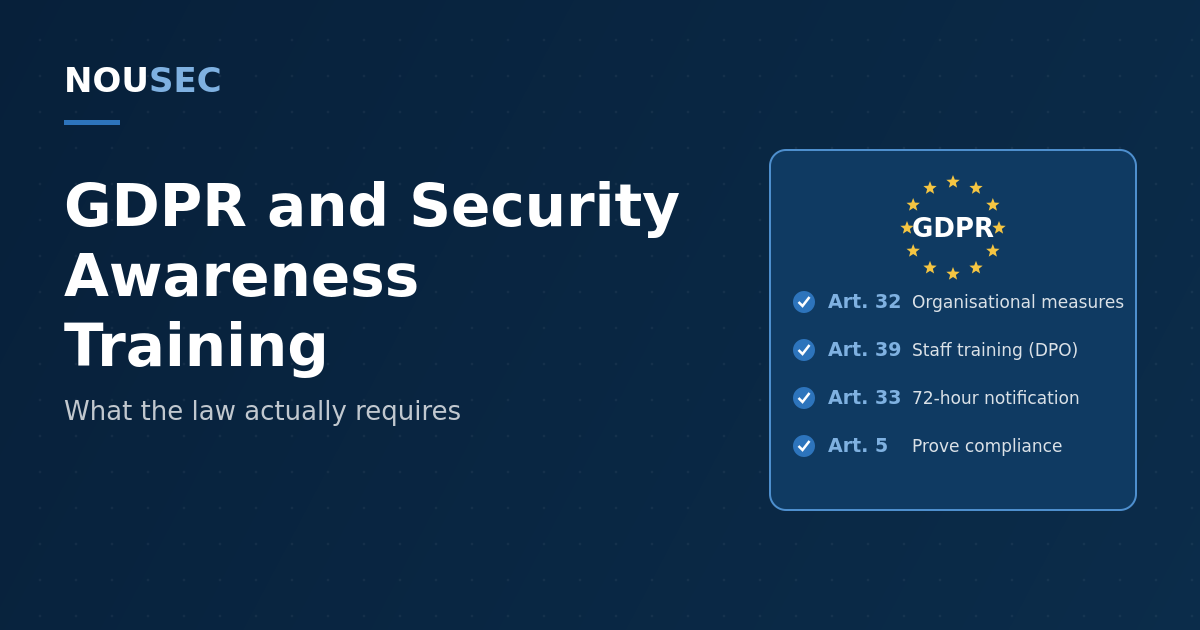
Ask a compliance officer whether the GDPR requires security awareness training and you will get a lawyer's answer: not explicitly. The regulation's 99 articles never contain the phrase. Ask a supervisory authority the same question after a breach, and the answer sounds very different. When the UK's ICO fined Interserve £4.4 million over a breach that started with one phishing email, inadequate staff training was among the failings it cited. The gap between those two answers is where a lot of European organizations are currently exposed.
The exposure is not theoretical. ENISA's Threat Landscape 2025 found phishing was the initial intrusion vector in 60% of the incidents it analysed across the EU — roughly three times the share of technical vulnerability exploitation — and the Verizon DBIR continues to attribute 62% of breaches to the human element. If most personal data breaches begin with a person, then the "appropriate organisational measures" the GDPR demands must reach people, not just firewalls. This guide maps exactly where training obligations live in the regulation, what enforcement practice shows regulators expect, and how to build a program that stands up in front of a supervisory authority.
Where training hides in the GDPR text
The GDPR's training obligation is assembled from several provisions rather than stated in one. Reading them together is what regulators do — so it is worth doing yourself.
| Provision | What it says | What it means for training |
|---|---|---|
| Art. 5(1)(f) + 5(2) | Personal data must be protected against unauthorised processing ("integrity and confidentiality"), and the controller must be able to demonstrate compliance | Untrained staff are a foreseeable path to unauthorised processing; accountability means proving you addressed it |
| Art. 32(1) | Implement "appropriate technical and organisational measures" proportionate to the risk | Training is the canonical organisational measure — regulators treat its absence as an Art. 32 failure |
| Art. 32(4) | Anyone acting under the controller's authority must process data only on instruction | Staff cannot follow instructions they have never received; this clause presumes instruction exists |
| Art. 39(1)(b) | The DPO's tasks include "awareness-raising and training of staff involved in processing" | The only place training is named outright — if you must have a DPO, training is part of their statutory job |
| Art. 33 / 34 | Breach notification to the authority within 72 hours; to individuals when risk is high | Employees must recognise and report incidents fast enough for the legal clock to be met |
| Art. 47(2)(n) | Binding Corporate Rules must include "appropriate data protection training" | For multinationals using BCRs, training is an explicit written commitment |
Two things follow from this map. First, training under the GDPR is a security obligation, not an HR formality — it sits inside Article 32 alongside encryption and access control, and is judged by the same standard: appropriate to the risk. Second, because of Article 5(2), running training is not enough. You must be able to demonstrate it — who was trained, on what, when, and with what result.
The GDPR never uses the phrase "security awareness training." Regulators read it into the law anyway — and when a breach happens, they treat its absence as a security failure, not a paperwork gap.
What enforcement actually looks like
The Interserve decision remains the clearest template for how a training gap becomes a fine. An employee opened a phishing email while working remotely; malware followed; attackers reached 283 systems and the personal data of around 113,000 current and former employees. The ICO's penalty notice did not stop at the outdated servers — it expressly cited the failure to provide adequate staff training, noting that the employee who triggered the breach had not completed data protection training, and set the fine at £4.4 million under the UK GDPR's Article 32.
The economics of that trade are stark. IBM's Cost of a Data Breach report puts the average breach at $4.99 million — before any regulatory penalty is added on top. Article 83 tiers the fines: infringements of Article 32 itself reach €10 million or 2% of global annual turnover; infringements of the Article 5 principles reach €20 million or 4%. A supervisory authority assessing the fine amount is directed by Article 83(2) to weigh "the degree of responsibility of the controller... taking into account technical and organisational measures implemented" — which is precisely where a documented, risk-based training program changes the outcome, and an absent one aggravates it.
It is worth being precise about what regulators are not saying. No authority expects training to make employees infallible, and a well-run program does not become a liability because one person still clicked. What decisions like Interserve punish is the indefensible version: no training before access, no refresh cadence, no records, no relationship between the training content and the threats the organization actually faces.
What "appropriate" training means in practice
Because Article 32's standard is risk-appropriateness, the question shifts from did you run training? to was the training proportionate to the risk and did it work? That is a measurement question, and the evidence gives clear direction. A large randomized study at UC San Diego Health (Ho et al., IEEE S&P 2025) found annual compliance-style training alone had no significant effect on phishing failure rates — while embedded, in-the-moment training delivered at the point of failure did. Longitudinal research (Reinheimer et al., SOUPS 2020) shows detection skill decays measurably within four to six months. And KnowBe4's benchmark data shows baseline phish-prone rates of 33.2% falling to 4.2% after twelve months of combined training and simulation — a trajectory only visible because it was continuously measured.
For a GDPR program, the implication is that the annual slideshow satisfies neither the regulator's standard nor the threat. What does is a continuous loop — assess risk, train against it, simulate realistic attacks, measure who remains vulnerable, and adapt. That loop also produces, as a by-product, exactly the evidence trail Article 5(2) demands. (For the business case behind that loop, see our analysis of security awareness training ROI.)
Building a defensible GDPR training program
- Anchor training in your Article 32 risk assessment. Start from the threats your data actually faces — for most organizations, ENISA's 60% figure means phishing and social engineering top the list. Training content that mirrors the risk register is the first thing that makes a program defensible.
- Train before access, then by role. Article 32(4) presumes staff are instructed before they process data, and the ICO faulted Interserve on exactly this point. Make completion a precondition for system access, and layer role-specific modules for the high-risk few: finance (payment fraud), HR (the data-richest target), help desk and executives.
- Replace the annual event with a continuous cadence. Keep a documented annual refresher for the compliance record, but do the real work between: short monthly reinforcement, simulations, and immediate teachable moments when someone clicks — the format the evidence says actually changes behavior.
- Simulate and measure, don't just instruct. Phishing simulations turn training from an attestation into a dataset: who clicked, who reported, how fast. Rolling those signals into a Human Risk Score gives you the risk-proportionate view Article 32 asks for — and shows regulators you measure the measure.
- Document relentlessly. Completion records, content versions, dates, simulation results, remediation actions. Under Article 5(2), a program you cannot evidence is a program you do not have. This file is the first thing you will be asked for after an incident.
- Wire reporting into the 72-hour clock. Article 33 gives you 72 hours from awareness — and awareness starts with the first employee who notices something wrong. Train the reporting reflex explicitly, make the report channel one click, and celebrate reporters rather than punishing clickers. Reported-in-minutes is the difference between a contained incident and a notifiable breach.
A structured security awareness training program built this way does double duty: it reduces the probability of the breach, and it materially improves your position under Article 83 if one happens anyway. The GDPR's drafters may never have written the words "security awareness training" — but they wrote a law in which not doing it is one of the most expensive omissions a European organization can make.
Frequently asked questions
Does the GDPR explicitly require security awareness training?
Not in those words. The GDPR never uses the phrase 'security awareness training.' But Article 32 requires 'appropriate technical and organisational measures' proportionate to risk, Article 32(4) requires controllers to ensure staff only process data on instruction, and Article 39(1)(b) makes staff training an explicit task of the Data Protection Officer. Supervisory authorities consistently read these provisions together as a de facto training obligation — and have cited inadequate training as a factor in enforcement decisions.
How often should employees be trained to satisfy GDPR expectations?
The regulation sets no fixed interval — the standard is 'appropriate to the risk.' In practice, a single annual module is hard to defend: peer-reviewed research shows phishing detection ability measurably decays within four to six months of a training session. A defensible cadence combines onboarding training before system access, an annual documented refresher, and continuous reinforcement through simulations and short in-the-moment teachable moments, with records kept for all of it.
Can a company actually be fined under GDPR for not training employees?
Yes — as part of an Article 32 security failure. The UK ICO fined Interserve £4.4 million after a phishing email led to a breach affecting around 113,000 employees; inadequate staff training was one of the failings expressly cited. Article 32 infringements carry fines up to €10 million or 2% of global annual turnover, and breaches of the Article 5 principles up to €20 million or 4%, whichever is higher.
Is a successful phishing attack a personal data breach under GDPR?
It is if personal data is compromised — which is usually the case once a mailbox, HR system, or customer database is accessed. That triggers Article 33: notification to the supervisory authority within 72 hours of becoming aware of the breach, and Article 34 notification to affected individuals where the risk to them is high. This is why employee reporting speed is a compliance metric, not just a security one: the 72-hour clock is only survivable if the first employee who notices says something immediately.
NOUSEC simulates attacks across 8 channels and turns the results into one number your board can read.
Book a demo