Pig Butchering Scams: An Enterprise Defense Guide
Pig butchering is now a $64B criminal industry that reaches employees at work. Why the long con is an enterprise risk — and how to build a defense.
On 14 October 2025 the US Department of Justice seized approximately 127,271 bitcoin — about $15 billion — from the chairman of Cambodia's Prince Group, indicted for running forced-labor compounds dedicated to pig butchering fraud. It was the largest forfeiture action in the history of the Department of Justice. Not for ransomware. Not for a nation-state intrusion. For a scam that starts with a friendly text message.
Security teams have largely filed pig butchering under "consumer problem" — something for banks and the FTC to worry about. That filing is out of date. The operations behind these scams are industrialized, they reach employees on the same channels and devices they work on, and their fallout — financial devastation, insider risk, money mule recruitment, and finance teams groomed by professional manipulators — lands squarely inside the enterprise. This guide covers what the machine actually looks like in 2026 and what a workforce defense program should do about it.
The industrial machine behind the "wrong number" text
The defining fact about pig butchering is that it is not the work of lone romance scammers. It is a criminal industry with campuses, shift schedules, HR departments and quotas — staffed substantially by trafficking victims. A February 2026 report from the UN Human Rights Office, A wicked problem, estimates at least 300,000 people working in scam operations across Southeast Asia, many held behind barbed wire, with victims traced to at least 66 countries. The DOJ's Prince Group complaint describes compound records tracking fraud profits room by room, and "phone farms" running thousands of devices and millions of phone numbers.
The revenue side is just as organized:
| Metric | Figure | Source |
|---|---|---|
| Global annual revenue of scam centres | ~$64 billion | UN OHCHR, A wicked problem, Feb 2026 |
| Generated in the Mekong region alone | >$43.8 billion/yr | UN OHCHR, A wicked problem |
| US crypto-linked fraud losses, 2025 | >$11 billion (181,565 complaints, +22% YoY) | FBI IC3 2025 Annual Report |
| US investment-fraud losses, 2025 | >$8.6 billion — 72% crypto-linked | FBI IC3 2025 Annual Report |
| Single largest enforcement action | 127,271 BTC (~$15B) forfeited | DOJ, Oct 2025 |
Two details in those numbers deserve a security leader's attention. First, investment fraud — the category pig butchering dominates — is the single most expensive fraud type Americans report, ahead of business email compromise. Second, the growth is not slowing: crypto-linked complaint losses rose 22% year over year even as awareness campaigns multiplied. The playbook works, and the operators can afford the best tooling — including generative AI for fluent, personalized conversation at scale.
Why this lands on the CISO's desk
Pig butchering does not breach your network, so it never shows up in your incident queue. It breaches your people instead — and the business impact arrives later, wearing a different label.
It arrives through work channels. The approach vector is a smishing text, a WhatsApp message, or increasingly a LinkedIn connection request from a plausible industry peer. Employees fielding these on corporate phones, during work hours, are making trust decisions your security program has never trained them for: the lure contains no link, no attachment, no credential prompt — nothing a secure email gateway or phishing filter can see.
Financial devastation is an insider-risk precursor. A victim who has quietly lost their savings — and possibly borrowed money — is under exactly the acute financial and emotional pressure that insider-risk frameworks flag. Shame keeps the loss hidden; desperation makes bad options attractive. An employee in that state with privileged access, payment authority, or salable data is a materially different risk than they were six months earlier.
The same grooming works on corporate money. The tactics — long rapport building, fabricated legitimacy, urgency at the moment of transfer — are the same ones behind CEO fraud and vendor payment scams. Finance staff who manage company treasuries have been steered toward fraudulent "investment platforms" and crypto opportunities, and small-business owners are prime targets precisely because business accounts hold more than personal ones.
Laundering networks recruit your employees. The billions flowing out of victims' accounts move through layers of money mules — often ordinary people recruited via "easy remote work" offers or by romance scammers who convert victims into accomplices. An employee moving scam proceeds through their accounts is a legal and reputational exposure the organization finds out about only when law enforcement calls.
Pig butchering never touches your infrastructure, so it never triggers an alert. The first indicator most organizations get is a changed employee — and by then the scam is months old.
The red flags that training should teach
The US Treasury's FinCEN issued a dedicated alert on pig butchering listing behavioral red flags. The pattern to teach is the combination — any one element can be innocent; together they are the scam:
- An unsolicited contact (wrong number, dating app, social media) that develops into an unusually attentive relationship with someone you have never met in person.
- Conversation that migrates quickly to an encrypted or private channel, away from the platform where it started.
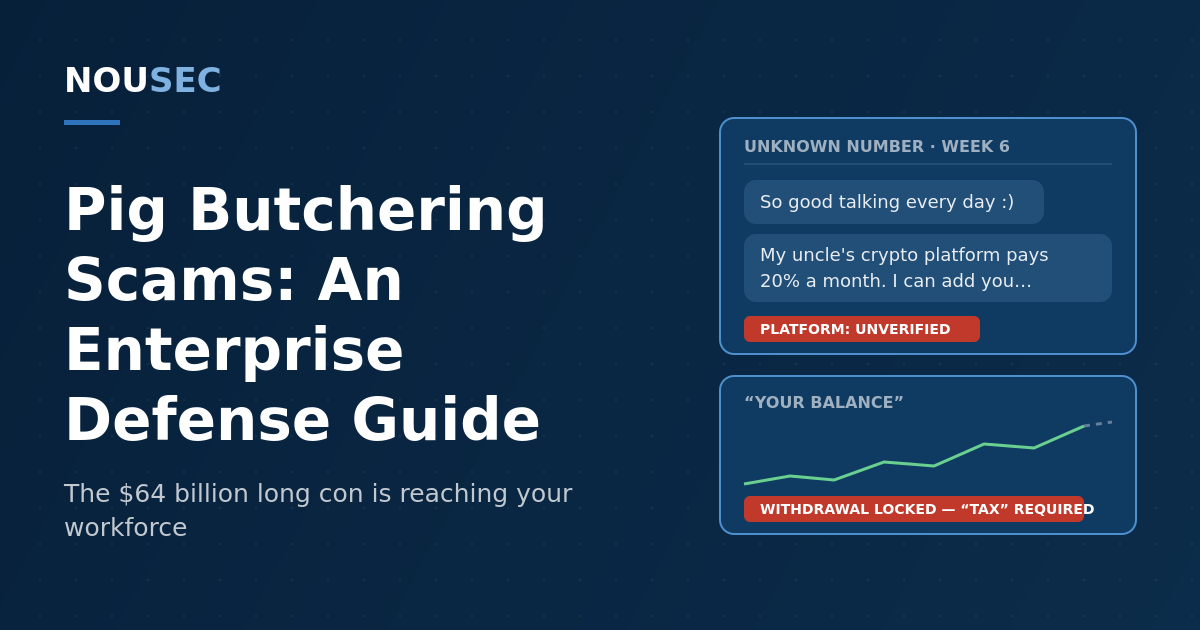
- An investment opportunity introduced only after weeks of rapport — typically crypto, typically on a platform you have never heard of, reachable only via a link your contact sends.
- Early small withdrawals that work perfectly, followed by pressure to invest much larger amounts.
- "Taxes," "fees," or "account upgrades" demanded before a large withdrawal can be released — the terminal stage of every pig butchering scam.
- For mule recruitment: any job or favor that consists of receiving money and forwarding it on, however plausible the cover story.
Building the workforce defense
The program that counters long-con fraud looks different from a click-rate reduction campaign, but it slots into the same machinery you already run.
1. Put the long con in the curriculum
Most security awareness training teaches employees to inspect a message. Pig butchering requires teaching them to recognize a relationship pattern that unfolds over months. Add a module built on real case narratives — the FinCEN red-flag list gives you the storyboard — and frame it as protecting employees and their families, not just the company. Content that helps people at home is also the training employees actually remember.
2. Simulate the channels the scam uses
If your simulation program only sends email, it is testing the wrong door. Extend simulations to SMS and messaging-app pretexts, including no-link, conversation-opening lures — the "wrong number" style message whose only goal is a reply. What you are measuring is not click rate but engagement-and-report rate: does the employee recognize the opener and report it, or start chatting?
3. Make reporting shame-proof
Victims stay silent because the loss feels humiliating — the UN report notes victims "too often face disbelief, stigmatization and even further punishment." Internally, your interest is the opposite of punishment: you want to know about the finance manager six weeks into a grooming operation before the wire, and about the devastated employee before desperation compounds the damage. State in writing that employees who report being targeted or victimized — even mid-scam — face no retaliation, and route them to real support (EAP, legal referral, bank escalation) alongside the incident response process.
4. Wire the finance function against the crossover
Treat unsolicited investment approaches to treasury and finance staff as reportable security events, the same category as a suspicious invoice. The controls you already built against BEC — out-of-band verification, dual approval over thresholds, no payment-instruction changes on the say-so of one channel — also stop the corporate variants of the long con, provided finance staff are trained to see "trusted contact suggests moving money" as one pattern, whatever the pretext.
5. Measure exposure like any other human risk
Long-con susceptibility correlates with the same signals a human risk score already aggregates: simulation outcomes across channels, reporting speed, and role-based exposure (payment authority, privileged access). Score the SMS and messaging-channel simulations separately — an employee who catches every email lure but engages with conversational openers is exactly the profile this threat exploits, and the per-role view tells you where a targeted refresher matters most.
The bottom line
Pig butchering is what social engineering looks like when it is run as a $64 billion industry: patient, personalized, and aimed at people rather than systems. The human element already features in 62% of breaches — and this is the same attack discipline, pointed at your employees' savings first and your organization second. The defense is not a new tool. It is a workforce that recognizes manipulation patterns across every channel, reports without shame, and a program that measures both — before the machine on the other side finds the employee it wants.
Frequently asked questions
Are pig butchering scams really a workplace security problem?
Yes, in four concrete ways. Employees are approached on the same devices and channels they work on — LinkedIn, WhatsApp, SMS — often during work hours. Victims who lose savings become textbook insider-risk cases, because acute financial distress is a classic precursor. Finance and treasury staff are targeted with the same rapport-building playbook used in payment fraud. And laundering networks actively recruit ordinary employees as money mules. A scam that starts as a personal matter routinely ends as an organizational one.
How do pig butchering scammers make first contact?
The classic openers are an innocuous 'wrong number' text message, a dating-app match, or an unsolicited social media or LinkedIn approach. The first weeks contain no mention of money at all — the scammer builds a friendship or romance, often messaging daily. The investment 'opportunity' only appears once trust is established, which is why one-off phishing training does not prepare people for it.
What should someone do if they realize they are mid-scam?
Stop sending money immediately, regardless of sunk cost — 'fees' and 'taxes' demanded to unlock a withdrawal are part of the scam, not a way out. Preserve evidence: chat logs, wallet addresses, transaction records, platform URLs. Contact your bank or exchange at once, and file a report with the FBI's IC3 (or your national equivalent) as fast as possible. Be wary of 'recovery services' that promise to claw funds back for an upfront fee; regulators consistently warn these are usually a second scam targeting the same victims.
Why is it called pig butchering?
The name translates the Chinese phrase sha zhu pan — 'killing pig plate.' Scammers describe the months spent building trust and encouraging ever-larger deposits as 'fattening the pig,' and the final phase, where the victim is stripped of everything including borrowed money, as the slaughter. Many governments and platforms now prefer the term 'financial grooming,' which better reflects the victim's experience.
NOUSEC simulates attacks across 8 channels and turns the results into one number your board can read.
Book a demo