The Request for Every Employee's W-2
A CEO-style email asks payroll for every employee's W-2. How the W-2 scam works, what the IRS has recorded, and the checks that hold in tax season.
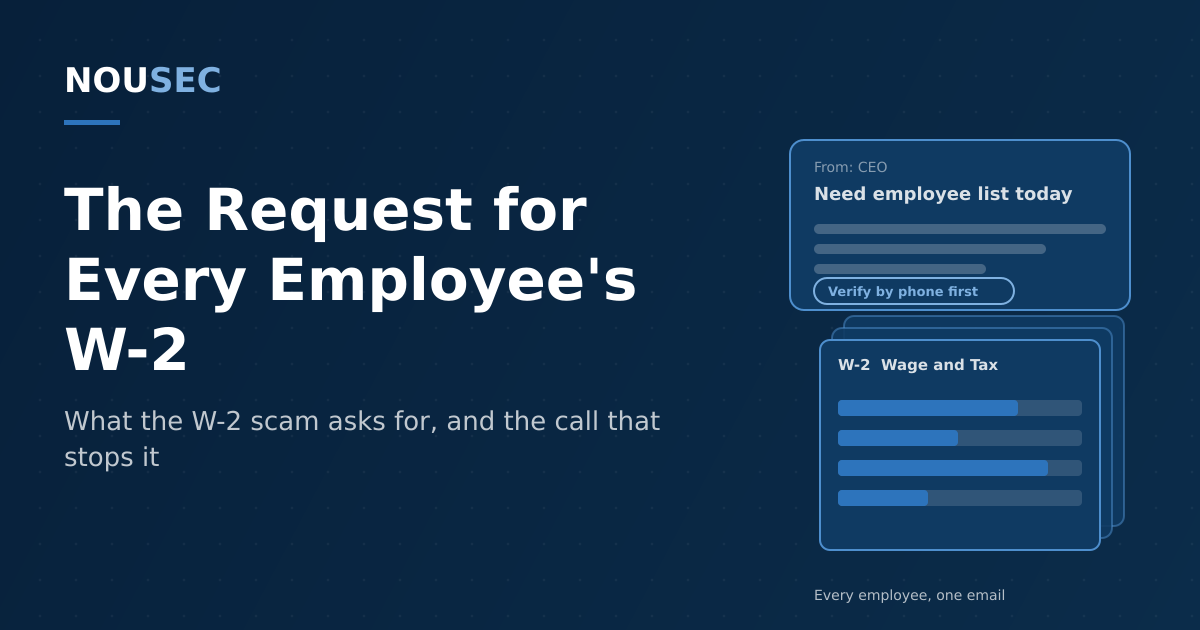
Every January, a payroll clerk receives an email that appears to come from the CEO. It is short and polite and a little urgent: send the list of every employee and their W-2 forms before the end of the day. It reads like ordinary tax-season work, because issuing W-2s is ordinary tax-season work. That resemblance is the whole trick, and the IRS has been warning about it since at least 2016.
A W-2 scam is a business email compromise in which an attacker impersonates an executive to get payroll or HR to release employee W-2 forms, which contain names, Social Security numbers, addresses and wages. The stolen data is used to file fraudulent tax returns, a crime known as tax identity theft, and to open accounts. The defense is procedural rather than technical: no W-2 data leaves the company on the strength of an email alone.
The one email that asks for everything
The W-2 scam is a close cousin of the business email compromise that drains bank accounts, but the payload is different. Instead of a wire transfer, the attacker wants a file. The message usually says the executive needs the full list of employees, their Social Security numbers and their W-2 wages for a pending review, a loan, or a benefits project, and asks for it as a single attachment or a reply. Sometimes the sender is a spoofed look-alike address. Sometimes it is a real executive mailbox that the attacker has already taken over.
Several features make the request easy to accept. It comes from a name the recipient knows. It asks for something payroll does produce every year. It is framed as urgent but not alarming, and it often arrives during a busy stretch when a lot of tax paperwork is already moving. The impersonation attack has no link to hover over and no attachment to scan, which is why filters and generic phishing awareness catch so little of it.
Why a W-2 list is worth more than a wire
A single W-2 is a complete identity package for tax purposes. The name, address and Social Security number let someone file a return early, before the real employee does, and claim a refund into a bank account the attacker controls. A full list multiplies that by the headcount. The IRS describes the consequence plainly in its 2022 Security Summit guidance: businesses often do not find out they have been scammed until an employee reports that a fraudulent return has already been filed.
That delay is the real danger. The loss is not in the company's bank account, so it does not trigger the alarms finance watches. It surfaces months later, as a rejected tax return or a letter from the tax authority, and by then the W-2 data has been used. The employee experiences the fraud, and the employer experiences the support queue.
What the record shows, and what it does not
The most-quoted figures on this scam are old, and it is worth being precise about which year each one comes from. The table below lists the official and near-official sources we could verify, with the year of each release.
| Year | Source | What it reports |
|---|---|---|
| 2017 | IRS release IR-2017-130 (historical) | Victim organizations rose to 200 from 50 in 2016, affecting several hundred thousand employees; the FBI reported a 1,300% increase in identified losses since January 2015 |
| 2018 | IRS release IR-2018-243 (historical) | Called it "a dangerous scheme aimed at payroll and human resource offices" and urged employers to require verbal confirmation before sending W-2 data |
| 2022 | IRS release IR-2022-211 (historical) | Described an executive impersonator asking payroll for employee W-2s, with discovery often coming only when an employee reports a fraudulent return |
| 2026 | IRS Dirty Dozen 2026 (IR-2026-30) | Lists spear-phishing and malware aimed at tax professionals and businesses, and overstated-withholding schemes that use W-2 forms |
| 2026 | IRS Form W-2 data theft guidance (reviewed May 2026) | Current reporting channels and the executive-spoofing pattern, with no new loss counts |
Two things stand out. First, the IRS has continued to treat this as an active threat through 2026, not a relic. Second, the agency's published loss counts for W-2 data specifically are from 2017, and we did not find a current, verifiable count that isolates W-2 requests. The broader picture comes from the FBI's business email compromise numbers: the Internet Crime Complaint Center's 2025 report recorded $3.046 billion in BEC losses across 24,768 complaints. W-2 requests are one variant inside that category, so the figure supports the scale of the problem without measuring the W-2 share of it.
Why payroll and HR are the easiest targets
Payroll and HR are not careless. They are asked for sensitive data as a normal part of their job, which means a request for sensitive data does not feel unusual. Trade reporting on the IRS's 2026 warnings noted that impersonation of HR, payroll and executives aims at W-2 downloads, payroll portals and requests to verify tax information, and that attackers now pair written messages with AI-generated text and cloned audio. The Verizon DBIR 2026 puts the human element in 62% of breaches, and this is a human-element attack by design.
The authority cue does most of the work. A subordinate who would question a stranger will often comply with a request that appears to come from the CEO. This is the authority principle of influence applied to a spreadsheet. In 2016, then-IRS Commissioner John Koskinen gave the simplest possible instruction, as reported at the time by Fisher Phillips:
"If your CEO appears to be emailing you for a list of company employees, check it out before you respond."
That advice is still the core of the defense. The problem is that many organizations have no procedure that makes checking it out easy, socially safe, or mandatory.
A verification procedure that survives January
The defense is a written process that is short enough to follow under pressure. A practical version has five parts.
Make W-2 and SSN data a controlled release. Write down who may send employee tax data, to whom, and by what channel. The IRS has urged businesses to put protocols in place for sharing sensitive employee information, and to have two people review any distribution of sensitive W-2 data or wire transfers.
Confirm by voice on a number you already hold. Any request for W-2s is confirmed by phoning the requester at a number from the company directory, never a number supplied in the email. The IRS's guidance has long said the same: confirm verbally using previously known telephone numbers, not numbers listed in the message.
Make the request-and-release path visible in your mail system. Flag external senders and mismatched reply-to addresses, and color-code external email so staff can see at a glance when a "CEO" message comes from outside. Look-alike domains are the most common disguise, and a recipient who has been told to look for them will catch many of them.
Brief the people who receive these requests before tax season. Payroll, HR, finance and executive assistants need a short, specific briefing in November or December, not a reminder in March. Include the phrases the scam uses and the rule that no one is criticized for pausing to verify.
Rehearse it. A role-based simulation with a W-2 pretext will show you who verifies, who forwards without thinking, and how long reporting takes. Feed those results into each team's human risk score, so the people who hold the most sensitive data get the most practice.
Brief the employees who will be impersonated
The IRS's guidance adds a point worth using in employee communications. The agency does not initiate contact with taxpayers by email, which gives staff a simple rule to share: the tax authority will not email you asking for a password, a W-2 or a bank detail. Employees should also know what to do if their own data was released. The IRS suggests notifying affected staff early, pointing them to the identity theft guidance, and recommending that they consider a credit fraud alert or freeze.
Those notifications matter because the employee is the one who sees the damage first. A company that tells its people within days, with clear instructions, gives them time to watch for an unexpected rejected return. A company that waits for the employee to call has already lost the head start.
If the list has already gone out
Treat a sent W-2 list as a reportable incident the same day. The IRS asks businesses to email [email protected] with "W2 Data Loss" in the subject line, including the business name, EIN, contact details, a summary, and the number of employees affected. For a phishing email the company did not act on, the IRS asks for a plain-text copy sent to [email protected] with "W2 Scam" in the subject. Report the incident to the FBI's Internet Crime Complaint Center as well, and tell the affected employees. Then review how the request got past the process, because the next one will look just as ordinary.
The W-2 scam is not a clever attack. It is a well-documented request that works when a company has not decided, in advance, that the answer is "call me first." Make that decision in November, and January is just another month.
Sources
- Form W-2/SSN data theft: information for businesses and payroll service providers — IRS, page reviewed 12 May 2026. Used for: the executive-spoofing pattern, the request for "a list of all employees and their Forms W-2," the statement that the IRS does not initiate contact by email, and the reporting addresses.
- Don't Take the Bait, Step 6: Watch Out for the W-2 Email Scam — IRS release IR-2017-130, 15 August 2017 (historical content). Used for: 200 victim organizations in 2017 versus 50 in 2016, and the FBI's 1,300% figure.
- Security Summit warns employers: Be alert to identity theft and W-2 scams — IRS release IR-2018-243, 6 December 2018 (historical content). Used for: the "dangerous scheme" description and the verbal-confirmation recommendation.
- IRS Security Summit partners wrap up National Tax Security Awareness Week — IRS release IR-2022-211, 2 December 2022 (historical content). Used for: the discovery-delay point.
- Dirty Dozen tax scams for 2026 — IRS release IR-2026-30, 5 March 2026. Used for: the 2026 spear-phishing and W-2-based withholding scheme entries.
- FBI IC3 Internet Crime Report 2025 — FBI Internet Crime Complaint Center, April 2026. Used for: $3.046B in reported BEC losses across 24,768 complaints.
- Verizon Data Breach Investigations Report — Verizon, 2026 edition. Used for: 62% of breaches involving the human element.
- IRS and payroll scam coverage, March 2026 — Thomson Reuters Checkpoint, 12 March 2026. Used for: the description of HR and payroll impersonation targeting W-2 downloads and direct-deposit changes.
- HR Departments Beware: Major Tax Season Phishing Scheme Claims Multiple Victims — Fisher Phillips, 24 March 2016. Used for: the Koskinen quotation and the description of CEO-spoofed requests for employee W-2s.
Frequently asked questions
What is a W-2 scam?
A W-2 scam is a business email compromise in which an attacker impersonates a company executive to persuade payroll or HR staff to send the W-2 forms of every employee. The IRS describes it as a scheme aimed at payroll and human resource offices, and it works because the request looks like routine tax-season paperwork.
What information is on a W-2 form?
A W-2 lists an employee's name, address, Social Security number, annual wages and the taxes withheld. That combination is enough to file a fraudulent tax return in the employee's name, which is why the forms are the target rather than the payroll system itself.
Why are payroll and HR staff the main targets?
They hold the forms and the authority to release them, and they receive legitimate requests for tax and payroll data every week. The IRS has warned for years that scammers pose as executives to payroll and HR offices, and the attacker needs no malware or stolen password to ask a payroll clerk for a spreadsheet.
What should we do if W-2 data was already sent to a scammer?
Act quickly. The IRS asks businesses to email [email protected] with 'W2 Data Loss' in the subject line, notify affected employees so they can watch for fraudulent returns and consider a credit fraud alert or freeze, and report the incident to the FBI's Internet Crime Complaint Center. Speed matters because the IRS says time is critical for helping affected people.
NOUSEC simulates attacks across 8 channels and turns the results into one number your board can read.
Book a demo